The Eurovision Song Contest

By Mareike Rupaner, Germany

1

The Eurovision Song Contest (ESC) is an international competition in Europe. European nations must choose each year a singer, who represents their county. The best singer, who has the post points, wins the contest. He hosts the next contest in next year in May.

It all starts on the 24 March 1956 with seven nations. A very strict rule fo2r participants was to sing in their country’s national language, but it relaxed with the year 1973. After that in 1999 the participants could sing in every language, which they want. Today it’s mostly in English.

In the contest, the participants have two options to get points. One the one hand, normal people can vote with televoting by telephone or SMS. On the other hand, there is a national jury, for each participant, which gives the other country’s points. The point’s Scala starts at 1 – 8, 10, and 12 points.

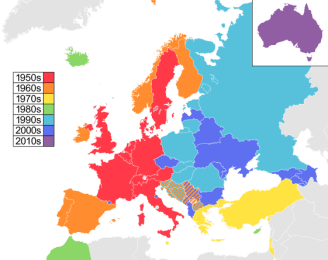
Since the 1990’s more and more countries join to the contest, so the organizer takes two sem3i-finals to find the Top 50. Only the “Big Five”: France, Germany, Italy, Spain and the United Kingdom are automatically in the Final.  The map shows, how many and in time the nations join to the contest by decade.
Fun Fact:  In 1974, ABBA wins the contest for Sweden

In 2015, the ESC celebrated 60 years anniversary. For the first time Australia joins to the contest and since that, it is very strong part in the contest.

The ESC is very important thing in Europe and in the European culture. Almost all nations of Europe join to one place, local or watching at the television.  Look and enjoy the next contest. On the 12th May, 2018, the Final is in Lisbon; don’t miss it or you can watch it next year 🙂

Take a look to the official site: https://eurovision.tv/ 4

The City of New York

by Mirna Vrdoljak, Austria

New York City is the most populous city in the United States. Counting 8 million people living there, it became one of the biggest megacities worldwide. It is described as the financial, cultural and media capital of the US and the whole world.

NYC offers so many themes to discuss- from the theatreal Broadway scene down to the financial capital in Wall Street, but here are some main facts to begin with.

Geography

  • The City of New York is located at the southern tip of the County of New York
  • an estimated population of 20 Million, counting the metropolitan area around New York in its 2017 Metropolitan Statistical Area
  • New York City is located on the East coast of the United States. It consists of islands surrounded by sea. (f.e. Hudson River)
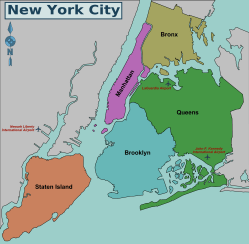
  • the city itself consists of five boroughs: Manhattan, Bronx, Queens, Brooklyn, Staten Island (Richmond)
  • Queens is the largest borough by area and Brooklyn by population, with more than 2.5 Million people living therenewyorkboroughs

    Demographics

    • New York City is home to more than 3.2 million residents born outside the United States, the largest foreign-born population of any city in the world
    • The city is a true melting pot with 44% white (German, Irish, Italian), 25.5% black (23% non-Hispanic black),12.7% Asian and only 0.7 Native American people
    • Like a lot of cities, New York’s boroughs and districts segregate different ethnical groups.
    • Manhattan is known as the business center where a lot of white and Asian people live. Queens and Brooklyn have a wide diversity of ethnical groups, containing a lot of artists and cultural driven people. Bronx is home to a lot of black and Italian immigrants.

koreatown


Attractions

As already mentioned, New York City is the center of the world’s of finance, fashion, music, art, theater, literature, and architecture. The city offers so much to see and to do that it just is not possible to see everything in one trip. Still there are some main places you should go to if you ever have the chance to land in NYC.

  • The Statue of Liberty

It was a gift to the United States in 1886 from France in honor of their friendship during the French Revolution. The statue became an American symbol of freedom.

  • Grand Central Terminal

It is NYC’s biggest hub for transportation, but also a breathtaking example of Beaux-Arts architecture. It’s much more than just a station. You can find cafes, restaurants and even a shopping mall inside it.

  • One World Trade Center

It’s the heighest and most expensive building in New York City. The tower was constructed with the memory of the Twin Towers in mind. Right next to the One World Trade center there’s the 9/11 Memorial Museum. The memorial is build in the footprint of the Twin Towers that were attacked on September 11 in 2001. It honors all the victims in the building.

Should animals be used for scientific and commercial testing? by Stella, Germany


animal test 11

General information:

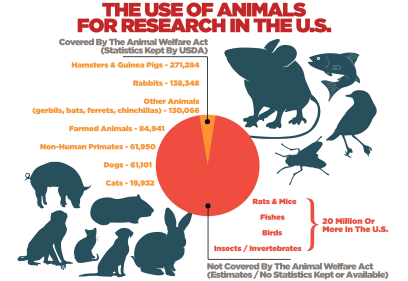
An estimated 26 million animals are used every year in the US for commercial and scientific testing including mice, rats, fish, birds, guinea pig, farm animals, cats and dogs.

They are used to develop medical treatments, determine the toxicity of  medications, check the safety of products destined for human use.

In additon, to the torment of the actual experiments, animals in laboratories are deprived of everything that is important and natural to them.
They are confined to barren cages, socially isolated and psychologically traumatized.
Most of the torture is legal.

Legal tests include: burning, poisoning, starving, forced, smoking, mutilating, blinding, electrocuting, drowning and dissecting without painkillers. They also get cut open without any painkillers.

The reality is that the majority of animal experiments do not contribute to improving the human health.


AGAINST
the scientific and commercial testing

Many organizations try to follow the three R rules to improve the torment of the animals using for scientific and commercial testing:
Replacement
replacing animals with non-animals tests
Reduction
using fewer animals to do research
Refinement
emphazies the fact, that if companies are going to use animals for your research, they have to make sure that those animals are treated at the highest (ethical) level

Alternatives to replace animals in science:

  • in vitro (test tube) test methods and models based on human cell and tissue cultures
  • computer models and simulations
  • stem cell and genetic testing methods
  • microdosing (in which humans are given very low quantities of a drug to test the effects on the body on the cellular level, without affecting the whole body system)

Why is replacing animals in science much better than using animals for testing? Are there any advantages in non-animal testing?

Yes, replacing animals in science with different alternatives has several advantages.
It is cheaper, faster and companies can test more chemicals.
It is not only more effective for science, but also more reliable and more human.

animal test 12animal test 123animal test 1234

PRO the scientific and commercial animal-testing

  • Animals themselves benefit from the results of animal testing
  1. If vaccines were not tested on animals, millions of animals would have died from rabies, distemper, feline leukemia, infectious hepatitis virus, tetanus, anthrax, and canine parvo virus.
  2. Treatments for animals developed using animal testing also include pacemakers for heart disease and remedies for glaucoma and hip dysplasia.
  3. Animal testing has also been instrumental in saving endangered species from extinction, including the black-footed ferret, the California condor and the tamarins of Brazil.


Vegan/Veganism

by Katharina Coenen


Veganism is a type of vegetarianism diet that excludes meat, eggs, dairy products and all other animal-derived ingredients. Many Vegans also do not eat foods that are processed using animal products, such as refined white sugar and some wines. They also don’t wear particular types of clothing, such as leather, fur and wool.

Vegan refers to either a person who follows this way of eating or to the diet itself. That is, the word vegan can be an adjective used to describe a food item, as in, “This curry is vegan”, or, it can be used as a noun, as in, “Vegans like cookies, too.”

But why would you choose to become a vegan ? They are many reasons. Let’s have a look.

Animals are a constant part of our lives. We share our houses with them, our beds, and we even consider them to be members of our family. While they may not be able to speak our languages, we value them highly. We interact with them and we often turn to them for emotional support. When they pass away, we mourn them.

We also believe that they enjoy being alive as much as we humans do, as they enjoy the company of others. Yet for other animals we stick forks and knives into their bodies and wear their skin as clothing. Is that morally right ? Maybe you think it is wrong to act violently against dogs or cats, but why do we think this? Animals around the world are dying just because we want to wear their skin, eat them or their products.

Some of us try to defend this by purchasing products that are marketed as “humane” or as produced “ethically.” However, these words are meaningless and actually do very little to give animals a better life. In any case, these terms comfort the public to believe it is okay to exhaust animals simply because we enjoy using them. We can change this social affliction and respect life by going vegan.

Consuming a plant-based diet also has significant benefits for our environment and health. Many studies show that eating more fruits and vegetables can dramatically change rates of cancer, diabetes, and heart disease.

Raising animals for food is also the single greatest human-caused source of destruction to our environment. In the rain forest, areas as big as soccer fields were cut down and used for growing soy beans for industrial livestock farming. Many rare animal species are in danger of extinction.

Personally i decided to going vegan. For me, its the next logical step, after being a vegetarian for over six years, to do the best as you can to help our environment and to reduce my ecological footprint. I never felt so happy with myself. 🙂

veganism picturevegan-cancer-1-1280x640VEGAN-THUMBNAIL-20170412-58ee4bc63df78cd3fc213c84

Maria Jose Ayala (Ecuador)

by Assam Al-hajji (Saudi Arabia)

Edited with Spinly

What is your favorite movie ?

her favorite movie is the hunger games.

What is the best movie you have ever seen ?

The Bet movie she has ever seen is NARNIA.

Do you like travels ? Why?

Yes, because she likes explore and meet new people.

Would you like to visit Saudi Arabia? Why?

yes, because she thinks it’s interesting country.

Have been in middle east before?

No,she has never been there.

Marina Botsch, Brazil

by Katharina Coenen


What kind of music is popular in your country?

It is Funk Music.

What is your favorite food ?marina botsch

I like Brazilian barbecue.

Do you have a brother or a sister ?

I have one brother his name is Lucas, he is nine years old and i have a sister her name is Carlina and she is twelve.

What are your hobbies ?

I like to hang out with friends, go shopping and watch movies on Netflix.

Which place in the world do you want to see ?

I have always wanted to see Greece, especially the beaches. They must be beautiful.


Interview of Maxime DELAERE

by Bettina Clauss, France

maxime delaere

What’s your favorite hobbies ?

His favorite hobbies are writing and swimmimg .

What’s your favorite meal ?

Raclette

Do you have pets ?

One cat

Where do you like to travel ?

Fiji Island because the landscape are beautiful and it’s hot.

What type of music do you like listen to  ?

French Rap


Bettina Clauss , France

WIN_20180410_12_21_35_Pro

Do you have a pet ?
Yes my thoroughbred horse , two cats , and one fish

What is your favorite meal ?
Sushi

What your favorite hobbies ?
horse jumping

What type of music do you listen ?
Techno , house

Why did you choose Santa Barbara ?
because of the sun and it’s s small city.

By Antoine Marotte from Belgium

What citizens of Santa Barbara think about EF students ?

By Jeanne Beaudoin, France & Sally Mousset, Belgium

We have chosen this subject because we hear every day a lot of things about how people see us. We have taken 2 videos of people who work on State Street and we have asked questions to a bus driver but he didn’t want to be recorded.

We are going to put the link of the 2 videos at the end of this article. People that we have recorded were very nice and both of them like the fact that there are all these international students in Santa Barbara.

However, the bus driver wasn’t so happy to have an EF school on Chapala Street. He said that most of us were friendly and polite, but otherwise he has problems with EF students. He told us that most of the time, they put their foot on the chairs. They also eat in the bus and they just leave their waste in the ground.

“Most of the time, they listened to their music and they aren’t polite with old people.” ” I always need to tell them to keep calm and to give their seats to the old person.”

Even though he has bad experiences with these students, he has no problem to one day host EF students because he thinks that it’s a good way to discover other countries in the world. He also told us that it’s a good idea to give the opportunity to these students to learn English here.

With this project, we learn that sometimes it’s true that we need to pay more attention to the citizens of Santa Barbara, but we really feel like home here so sometimes we forget that there are also rules here we need to follow.

Jeanne & Sally


Link of the video : https://youtu.be/DO5J57qUdmE


Trip

Stian Glatthard | Switzerland | 3/22/2018